Analytic Architecture Framework
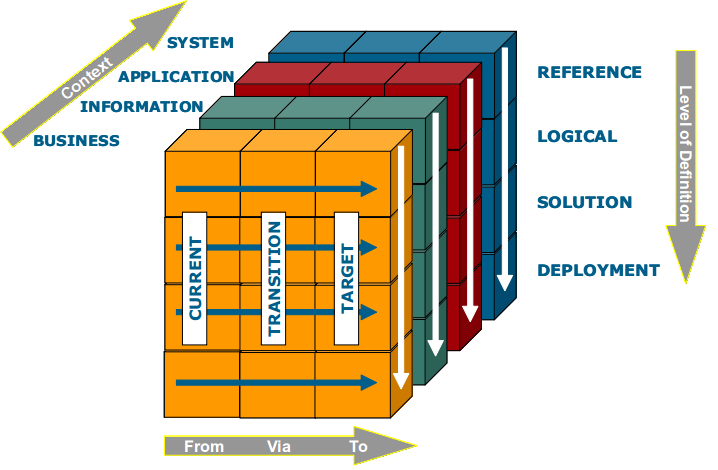
- "Architecture Cube" has 3 dimensions:
-
Level of definition: Reference, Logical, Solution, Deployment
- Context: Business, Information, Application, System
- Time: Current, Transition, Target
-
UDA design
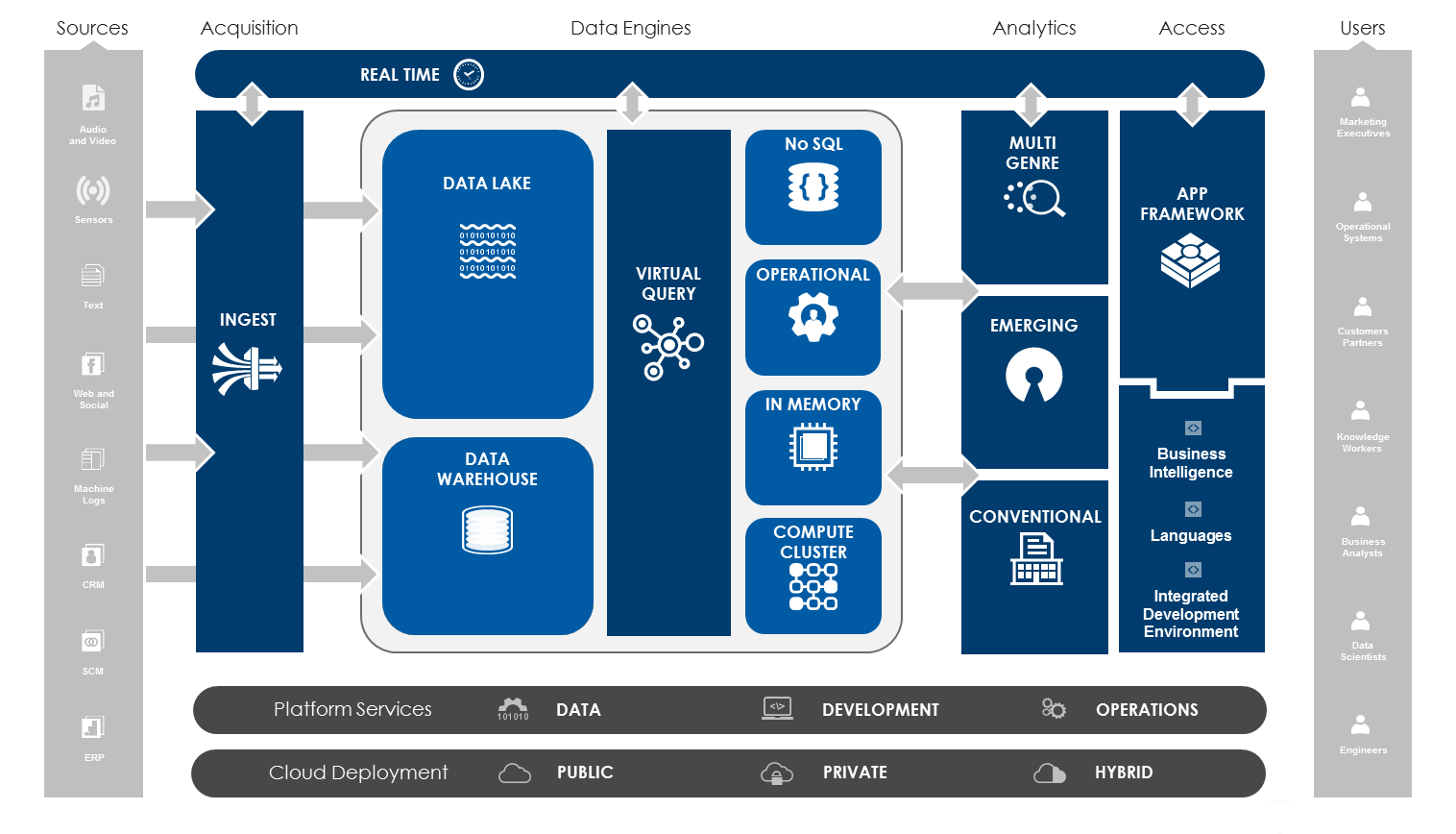
Teradata Reference Information Architecture
- Consists of 3 layers: Acquisition, Integrated and Access. Additionally has,
- Data Lab to host un-integrated data for quick prototyping
- metadata (name, definition, format and length)
Access Layer
- Base Tables -> Core (1:1) views -> Access Control -> Semantic -> Users
- Access Control: Security, Privacy and Bypass
- A Relational Model focuses on capturing business rules
- A Dimensional Model focuses on evaluation, that is, monitoring business through metrics
- The relationships in a dimensional model represent navigational paths v/s business rules in relational model
- Has measures, such as, amounts, counts, duration, that are mathematical
- Has meters, that is fact tables, that servers as buckets for measures
- Grain is meter’s lowest level of detail
- Has dimensions, are various ways to aggregate/filter measures
- Supports Navigations, such as drill up/down and across (cross meter measurements)
- Normal red flags: normalized structures, fuzzy grain, subtypes, too abstract
- Most Semantic Models are Dimensional Models, but can be
- Relational or Dimensional
- Conceptual, Logical or Physical
- Solution Modeling Building Blocks are collection of data model, SQL Views and mappings
- SMBB are to the access layer as iLDM are to Integrated Data Layer
- Building Steps:
- Plan: Know the: deliverables, timelines, cultures+biases, skills+resourcs
- Elicit Requirements: Interviews, Workshops, Documents, Prototyping
- Scope: Agree on business questions that will be answered.
- Grain Matrix tool: captures level of reporting for each measure
- Conceptual Data Model: defines business vocabulary
- Design: Build business solution (LDM) and technical solution (PDM)
- LDM: Add measures and dimension attributes to CDM
- PDM: Decide between star schema and snowflake
- physical implementation (views > PDM extensions (JI) > Denorm)