Machine Learning
- AI > ML > Deep learning
- AI: ability to learn by processing information, which will guide future processing abilities
- ML: Ability to learn without explicitly being programmed
- Deep learning: extract patterns from data using neural networks
- is learning from experience E, w.r.t. class of tasks T, performance measure P, if P improves with each E
- learning types: supervised, unsupervised, reinforcement, recommender system
- Singular or degenerate matrices don't have an Inverse
Concepts
-
ML
- Supervised: Classification, Regression
- Unsupervised: Clustering (segmentation), Anomaly Detection, Association Rules (recommendation engine)
-
Data types:
- Qualitative:
- Nominal: no ordering or ranking, e.g. Gender, Race
- Ordinal: some ordering, performance, document security classification
- Binary: True/False
- Quantitative:
- Discrete: quantities, number of children
- Continuous: length, volume
- Qualitative:
Supervised
- algorithm is given a set of correct answers
- Regression: continuous (real-valued) output, eg: what's the value of my house?
- curve fitting: linear, quadric
- classification: discrete output, eg: is it dog or a cat in the picture
- features or attributes determine the output
- Model representation:`
- training set: set of labeled data, consisting of \(m\) pairs of \(x\) input to \(y\) output $\((x,y)_{(i=1 \to m)}\)$
- hypothesis: is a function that predicts value \(y\) based on input \(x\)
- this is the output of the algorithm
- linear regression: linear correlation between
xandy- \(h(x) = \theta_0 + \theta_1 x\)
- if
xis just variable then it's called Univariate Linear Regression
- cost function
- Mean squared error function \(J_{(\theta_0, \theta_1)} = \frac{1}{2 . m} \sum_{i=0}^m (h_{\theta}(x^{(i)} - y^{(i)})^2\)
multi-variate linear regression
- when there is more than one feature
- feature scaling : every feature is scaled to have a value somewhere (not strict) in the range -1 and +1
- helps gradient descent algorithm find minimum in a reasonable time
- mean normalization : making all values scale between -0.5 and 0.5 (except x0)
\(X_i = \frac{(X_i - M_i)}{S_i}\) where \(M_i\) is the average, \(S_i\) is the range for each feature
i
- Number of features can be combined or expanded to suit the model, e.g.
- if you have frontage and width of the house, then you can combine into one feature called area
- if your feature isn't polynomial i.e. \(y = x + x^n...\), you can introduced each polynomial term as independent feature, thus converting polynomial regression to multi-variate linear regression.
minimizing cost function
| Gradient Descent | Normal Equation |
|---|---|
| Need to choose alpha | No need to choose alpha |
| Needs many iterations | DIrect solution by solving |
good whenn > 10,000 |
good when n is small |
gradient descent
- is calculated as derivative of the above formula
- learning rate (alpha) is the change that is applied to make cost function converge
normal equation
- allows you to solve for the minimize cost function.
- since cost function is a quadratic function, solving for derivative of cost function = 0, will yield that value. In other words, solve for when the slope is zero (parallel to x axis)
- normal equation for a multi-variate function will involve solving for partial derivative of each variable.
- design matrix is a matrix of
msamples byn+1features - since partial derivatives of multi-variate linear regression is complicated, use follow to find optimal value of theta (minimizes cost function): \(\theta = pinv(X^\prime * X) * X^\prime * y\), where \(X\) is the design matrix, \(X^\prime\) = \(X\) transposed, \(y\) is the value vector
- common causes of non-invertible matrices, i.e. ones that don't have an inverse (singular or degenerate matrices)
- Redundant features or linearly dependent features: e.g. area in sq. ft. and sq. mt.
- too many features: (
m < n), delete some features or use regularization
Picking an ML Algorithm

- Logistic Regression: Binary classification
- Simpler, used for establishing a baseline before trying more complex models
- Naive Byes: high-bias, low-variance model
- simple, low CPU usage, quick to train
- if the data grows in size and variance, other models might work better
- K-nearest-neighbor (KNN): classification by taking vote of K nearest neighbors, regression by taking mean of \(f\) value of K nearest neighbors
- quick to train
- easily fooled by irrelevant attributes obscuring important ones.
- query time and storage grows rapidly for large datasets, because it requires training data to be kept around
- decision tree:
- main advantage is easy to explain how the results were achieved simply by following the path from root to the leaf node
- they tend to overfit (can be mitigated by some techniques)
- Support Vector Machine (SVM): used for problems with exactly two classes; finds a hyperplane that separates two classes such that the points in either classes are farthest from points in the other class
- extremely accurate, less prone to overfit,
- linear SVM are easy to interpret and fast
- can handle complex, non-linear classifications by technique called kernel-trick
- cons: speed is heavily impacted if there are more than two classes, requires upfront training and tuning
- Artificial Neural Networks:
- great for nonlinear data with high number of features (such as character recognition, stock market prediction)
- con: hard to fine-tune, needs creating a new model with changed ata
- con: computationally intensive
- con: difficult explainability
Logistic Regression
- For binary classification, hypothesis function needs to be:
0 <= h(x) <= 1 - Sigmoid (aka Logistic) function = g(z), where z = (theta Transpose dot X)
- Decision boundary: A boundary that delineates probability that
y=1ortheta-T X >= 0 - symmetry breaking: Assigning random values to initial parameters in neural network, so they can converge better
- One-vs-all: When selecting one of a class, instead of binary, e.g. weather is cold, rainy, sunny or hot,
- Use logistic regression for each value of class (one v/s all)
Over-fitting
- applies to both, linear or logistic regression
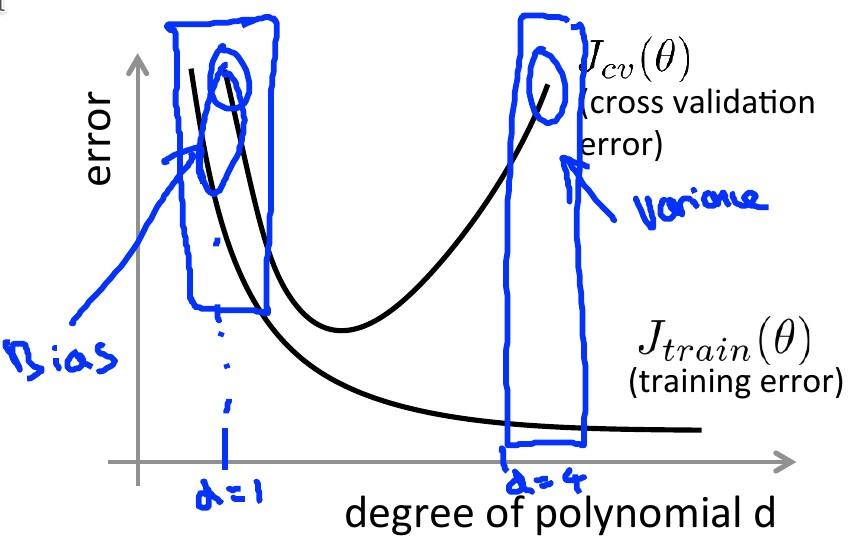
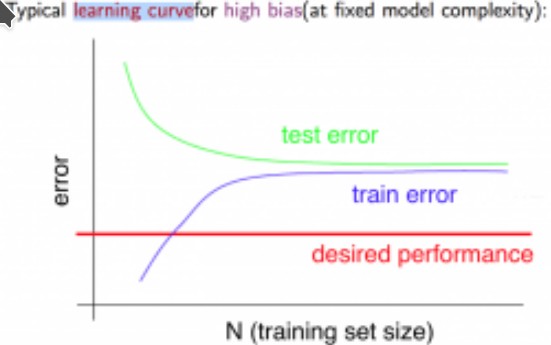
- High Bias: very simple graph such as linear, doesn't fit training set (samples) well. E.g. house price v/s size plateaus after certain size, which a straight line would predict that prices should go up proportionately with house size
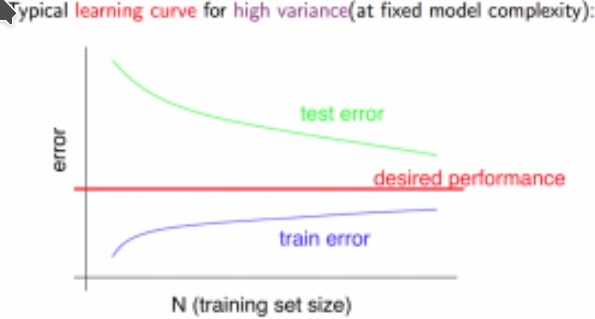
- High Variance: A complex graph, usually high-order polynomial, that does fit the entire training set, for example a quadratic function of price v/s size, but it is too uneven and probably won't fit if we had a larger training set. Due to unevenness, this is called high variance
- Solutions:
- Reduce number of features: manually or model selection algorithm
- Regularization: keep all features, but reduce the magnitude of \(\theta_j\) if features contribute only marginally
Regularization
- penalize certain features by adding a high multiplier (lambda aka regularization parameter) in the cost function.
- by convention lambda is not applied to \(\theta_0\) (i.e. feature with constant value 1)
- Cost function is then made up of two goals: 1) fit the training sample 2) keep theta small
- if lambda is too high, then it results in \(\theta_0\) being the only non-zero parameter,
- i.e. no other features playing any part (because they are close to 0), i.e. straight horizontal line, i.e. under-fitting
- if lambda is too high, then it results in \(\theta_0\) being the only non-zero parameter,
- Regularization also solves the non-invertibility/singular (aka degenerate) problem encountered during normal equation when \(m < n\) (training set has fewer samples than number of features)
- normal equation with regularization: \(\theta = inv(X^\prime \cdot X + \lambda \cdot L) * X' *y\) where L is like an identity matrix, except top element of the diagonal is
0
Diagnosing Algorithm Performance
- High Bias: under-fitting; High Variance: over-fitting
- ROT: split data into 3 sets:
- Training set: data to train the model with, ~60%
- (Cross) Validation CV: use for finding the best regularization parameter (lambda)
- Test set: estimate generalization error using
theta (d)
| techniques for High -> | Bias | Variance |
|---|---|---|
| training samples | ++ | |
| number of features | ++ | -- |
| polynomial features | ++ | |
| lambda (regularization) | -- | ++ |
| neural network # of neurons/layers | ++ | -- |
- ROT: If you have a low-bias algorithm, using very high number of training samples will benefit the algorithm the most
- If the answer to the question Can a human expert predict accurately based on given features? is yes, then algorithm is likely to be low-biased and will likely get a boost by using a larger training set
Stochastic Gradient Descent
- For large training set (in millions), optimize the batch (the default algorithm) gradient descent algorithm
- involves minimizing cost function using only one training sample during each iteration instead of the entire training set
- since theta calculation from just 1 training example can be misleading, iterate multiple training samples and average new theta value
- ROT: if there may be local minimas (noisy cost function curve), increase number of training samples to smoothen it out
- may not reach global minimum
- slowly decrease learning rate (alpha) with each iteration
- mini-batch gradient descent involves minimizing cost function using a small subset of training sample during each iteration
- online learning is a streaming learning where each data is used once to incrementally improve theta and then discarded
Error Metrics for Skewed Data
- Value
1by convention is used for value that is rare/anomalous (eg patient with cancer) - For skewed classification, eg if a patient has cancer (1) or no (0), traditional error rate doesn't give very accurate picture
- eg. if error rate is 1%, but number of patients with cancer is 0.5% then we are off by half
- Use Precision/Recall to measure skewed data.

- Precision: Of all positively classified cases how many are true positives:
True Pos / (True Pos + False Pos) - Recall: of all true positives, how many were classified as positives:
True Pos / (True Pos + False Neg) - Accuracy = (true pos + true neg) / (tot examples)
- Precision: Of all positively classified cases how many are true positives:
- Trade off between Precision and Recall
- e.g. instead of
h(x) >= 0.5if chooseh(x) >= 0.9we'll achieve high precision, but low recall (most predicted cancer patient do actually have cancer) - high precision means lower recall (eg
h(x) < 0.9more patients will be predicted as not having cancer than true cancer patients)
- e.g. instead of
- F Score : analytical way to choose between high precision or high recall algorithms. \(F = \frac{2PR}{P + R}\)
Unsupervised
- algorithm has no knowledge of results needed, tries to build a structure from a given dataset
- General types:
- clustering: market segmentation, social networking, general cohesiveness
- dimension reduction
- anomaly detection
- association
K-Means clustering
- Let,
Kbe the number of clusterCbe a cluster, with suffix from {1..k}Mube the Centroid of each cluster with suffix from {1..k}- centroids are initialized as randomly picking
Ksamples
- centroids are initialized as randomly picking
Jbe the cost or distortion- average of square of distance of each sample from the centroid of the cluster to which it is assigned
- Minimizing
Jinvolves two steps- cluster assignment: \(x_{(i)}\) is assigned to a cluster \(C_{(k)}\) whose centroid is closest to it
- move centroid: pick a new centroid as a average of all points within the cluster
- Can have local maxima
- for small values of \(m\), run algorithm
- Choosing \(K\) automatically
- Elbow method involves picking \(K\) for which reduction in \(J\) is maximum
ML Pipelines
- A pipeline consisting of individual ML or non-ML steps
- E.g. OCR in an image consists of these steps
- Finding text areas (using sliding window)
- Segmenting characters within text areas (using 1D sliding window to find gaps between characters)
- character recognition
- ceiling analysis
- objective: in a complex pipeline, evaluate which component to work on to improve pipeline efficiency
- evaluate pipeline efficiency, by providing ground-truth labels to components and pick the one that yields max improvements